
“Precision farming – AI and the food of the future”: students get to know artificial intelligence in a practical and interactive way at TouchTomorrow
Together with the Agro-Nordwest experimental field and other partners, the Dr. Hans Riegel Foundation is now introducing students interactively to the complex topic of artificial intelligence in the TouchTomorrow truck and lab (Deutsches Museum Bonn). The new AI theme station impresses above all with its clarity and relevance to everyday life.
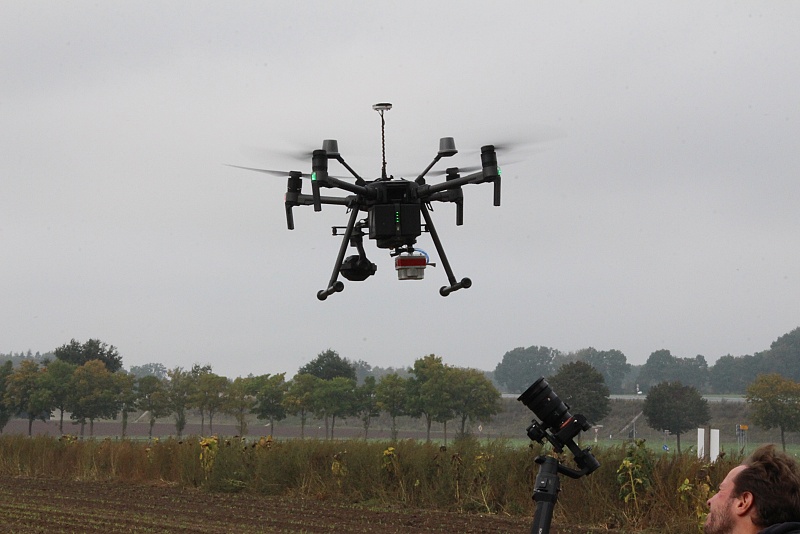
The world population is growing steadily. To ensure that everyone can still be fed in the future, agricultural production must increase by two thirds despite shrinking land. This can be achieved with state-of-the-art technology that delivers high yields on the available arable land using environmentally friendly methods. Self-driving tractors, field robots and drones: agriculture is already partly digital. Precision farming uses smart technologies with artificial intelligence. Its goal: to manage fields with varying growing conditions across different parts so that plants can thrive optimally. This further increases agricultural production and better protects the environment through targeted use of resources. This benefits organic farms as well as conventional agriculture.
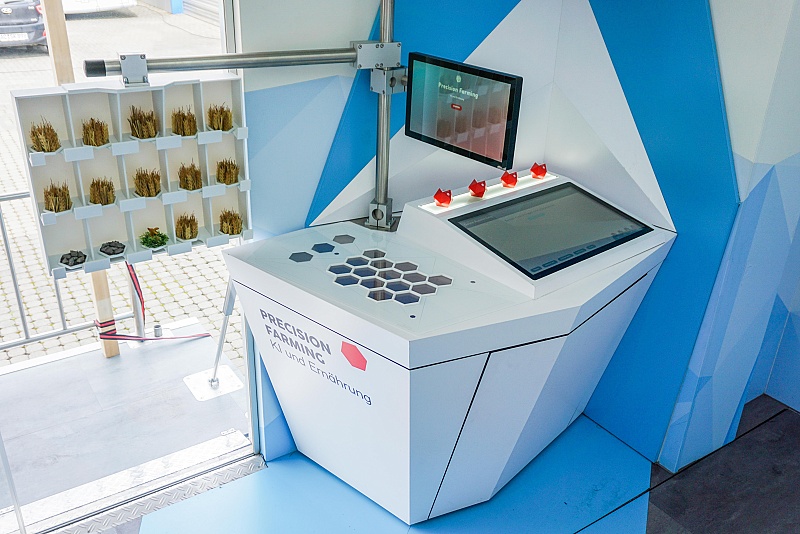
Structure of the new AI theme station
In precision farming, RGB (red-green-blue) sensors are used in agricultural machinery or drones, among other things. They record how plants reflect light. This allows conclusions to be drawn about the health of the plant, because a healthy plant absorbs blue and red light and reflects green light. If the sensor detects that a plant reflects little green light, the system can inform farmers about necessary measures such as supplying nutrients. This is visualized by the so-called “greenness index”. In agriculture, tractors and field robots can work fields autonomously using cameras and sensors.
Thanks to the expertise of the Agro-Nordwest experimental field, the design studio Rolf Rongen and RheinSiteMedia GmbH, this process could be realized in miniature as an interactive station in the TouchTomorrow truck and lab.
Students “train” the AI themselves and learn how it works…
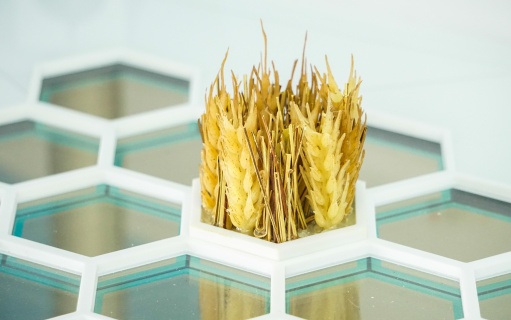
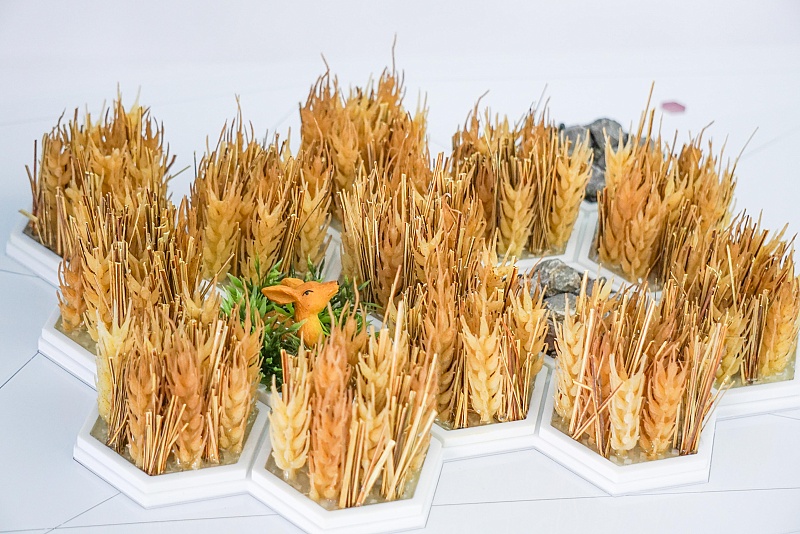
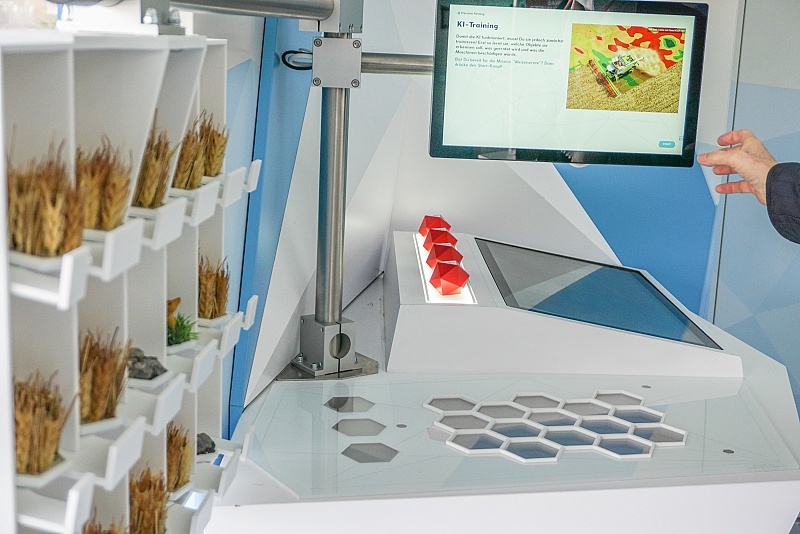
To create a basic understanding of artificial intelligence among students, they carry out the process steps “classification”, “training data”, “system” and “control” themselves. The AI is to be enabled to distinguish between plants and non-plants. First, the sample objects wheat, stone and animal are scanned individually and classified as such: wheat may be harvested, stone and animal may not. Then a field with 15 plots is randomly filled with the different objects and a scan of the entire field is triggered with the drone. If the process has been carried out correctly, an animated combine harvester drives across the digital field in a video sequence, harvesting in a straight line only at the grain symbol and driving around the stone and animal symbols.
Dr. Reinhard Schneider, Chair of the Board of the Dr. Hans Riegel Foundation: “Artificial intelligence is becoming an ever bigger part of our everyday lives, so knowledge and skills in this future topic urgently need to be promoted at an early stage. This often works best with a clear connection to everyday life: our daily food, such as the wheat in bread, is already grown and produced using the latest technologies. In the future, artificial intelligence and sensor technology will play an even greater role in so-called precision farming. These innovations are intended to further increase agricultural production to feed the world while better protecting our environment. Because of its great importance and successful implementation, we have had the interactive AI theme station produced for both the TouchTomorrow truck and the TouchTomorrow lab at the Deutsches Museum Bonn.”
Robert Everwand, project spokesperson of the Agro-Nordwest experimental field: “Agriculture is already mechanized and digitalized today. Electronics and computer science are already standard on machines. Agricultural processes are optimized by sensors, satellite data, imaging systems and other digital applications, for example in fertilization, crop protection and livestock farming. The increasing use of AI technologies also offers the opportunity for more sustainable and resource-saving agriculture. With the station in the TouchTomorrow truck, we show students that agriculture is by no means an old-fashioned industry. All the focus areas of the TouchTomorrow truck (mathematics, computer science, natural sciences and technology) can be found in the state-of-the-art agricultural industry, with exciting and challenging professions and fields of work. Agriculture and the question of how to feed a growing world population in an environmentally and climate-friendly way offers exciting and diverse prospects for the skilled workers of tomorrow.”
The TouchTomorrow truck
Since May 2018, the Dr. Hans Riegel Foundation's TouchTomorrow truck has been traveling to schools to inspire students to pursue education and careers in STEM (science, technology, engineering and mathematics) by experiencing and trying out future technologies. In addition to the truck, further TouchTomorrow offers have been created in recent years, including “TouchTomorrow Teaching” with teaching materials and training for teachers, the “TouchTomorrow Lab” at the Deutsches Museum Bonn and “TouchTomorrow Stream” as a livestream dialogue format for remote teaching situations such as Covid-19.
The Agro-Nordwest experimental field
Advancing digitalization will rapidly change the farm environment and the farming profession in the coming years. The Agro-Nordwest experimental field will therefore focus on farmers in crop production and their realistic farm environment and develop needs-based solutions. Involving users early on is a key success factor for making use of digital opportunities in agriculture and a prerequisite for better tapping potential and for assessing the risks of unintended side effects more precisely through testing in realistic pilot applications.
The Dr. Hans Riegel Foundation
The Dr. Hans Riegel Foundation continues the charitable legacy of the former HARIBO co-owner with the aim of supporting young people in shaping the future and accompanying them in the long term.
Dr. Hans Riegel founded a charitable foundation that is primarily operational and is intended to actively shape and implement its own projects in long-term partnerships. It was important to Dr. Hans Riegel that his foundation be an independent institution that can also support other social actors financially but above all tackles the challenges of the future itself and brings them into public discourse.
The founder saw education as the raw material of highly developed societies and the basis for competitiveness, progress and social well-being. His conviction: young people shape the future of our society economically and socially. Helping young people to lead independent, responsible and future-oriented lives is therefore a gain for everyone's future. Accordingly, supporting the education of young people who are eager to learn and perform, especially in STEM subjects, is the foremost purpose of the Dr. Hans Riegel Foundation.